As adults, we are familiar with how an occupational therapist helps adults regain or adapt skills for everyday activities such as self-care, work, and independent living,
As a parent or caregiver of an infant or toddler, you may wonder, how would an occupational therapist from Early Intervention Services help with my child’s development?
What does occupational therapy look like for an infant or toddler?
Heather Borci is a Team Leader and Occupational Therapist at Partners in Child Development’s Early Intervention Services, providing support and therapeutic services to infants and toddlers up to age three years old.
When a parent or caregiver thinks what occupies the day of children ages infant up to three years old, they identify three primary elements: eating, sleeping, and playing.
In this article, we are going to focus on how an occupational therapist (OT) from Partners in Child Development’s Early Intervention (EI) Services provides therapies and support to parents and caregivers to assist young children with eating, sleeping, and playing. We will also discuss OT’s important role in developing self-care skills as that becomes an important part of a child’s growth and gaining independence.
Our occupational therapists are motor therapists, observing infants and toddlers to see how they are using their bodies in eating, preparing for sleep, playing and completing self-care activities.
Eating
Learning to eat begins almost immediately at birth with an infant latching to the breast or being fed a bottle, learning to suck, swallow and breathe. These skills begin to develop at infancy but for some infants, there may be a variety of reasons why the infant is having difficulty. Feeding is obviously essential to infant development, but it is also important for building that special connection between an infant and their caregiver through skin-to-skin contact and eye contact. It is important for this daily activity to be positive for both the caregivers and the child, especially since feeding happens multiple times each day.
Feeding can be a source of stress for parents and caregivers. Occupational therapists from Early Intervention Services offer support and assistance to alleviate stress and help identify possible factors that may be interfering with nursing or bottle feeding for infants.
During the toddler years children develop preferences for food which can lend to parents describing their child as “a picky eater.” However, while having preferences is part of child development, some children’s sensory preferences or decreased oral motor skills can significantly decrease the foods a child will eat and cause disruption at any point in the progression from baby foods to table foods. Our OTs aid caregivers in identifying a child’s sensory preferences and chewing skills to develop a plan and strategies with the family to help expand the foods that their child can eat. We work together with each family to achieve the goal of positive mealtime experience for the child and family.
Many of our OTs have developed a specialization in feeding to help children, parents and caregivers address feeding concerns while reducing stress. Ideas and strategies empower parents and caregivers, building confidence in their ability to feed their child and being reassured their child is getting sufficient nutrition. Proper nutrition is essential for brain development. If you have concerns about feeding, early intervention is important to support the brain’s rapid development up to age three that has significant impact in a child’s life.
Feeding is one of the most common developmental concerns that families have when they reach out to Early Intervention Services for a free evaluation. Our experienced and skilled OTs are dedicated to working with young children and their families to assist with feeding concerns. Learn more about feeding concerns including impact stories.
Sleeping
Sleep is essential to the development of a young child as their brain is rapidly developing. Additionally, getting enough sleep affects us emotionally and supports our ability to learn.
When an infant or toddler is not getting enough sleep, everyone in the household is affected. This is understandably a source of stress. When it comes to sleep concerns, our OTs can provide ideas and strategies to help with sleep including discussing sleep patterns and sleep routines.
If additional strategies are needed to address sleep concerns, our EI program includes sleep specialists to offer additional strategies and therapies.
Learn more about sleep and EIs services including impact stories.
Playing
The third primary category that comprises an infant and toddler’s day is playing. As a parent or caregiver, you may wonder, what concerns would I have about an infant or toddler with respect to play?
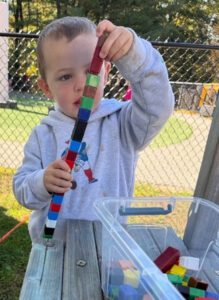
Playing enables a child to learn and interact with their environment and other people. Infants and toddlers are learning cause and effect as they engage in fine motor play. An infant shakes a rattle up and down and it makes a noise or an infant in their bouncy seat reaches up to swat at the toys hanging from the mobile and they move. If a child pushes the blocks with their hand, the blocks fall down. If the child places one block directly on top, aligning the edges it stays standing. If the child pushes a button with their index finger music plays and lights flash. Children learn that through their actions they can have a direct impact on the world around them.
Our OTs help families and daycare providers create play routines within the day that help strengthen the child’s upper body and improve coordination, visual motor skills, and fine motor skills all within the natural environment of their home or daycare.
Our OTs regularly work with infants and toddlers who are at risk of not meeting developmental milestones or are not achieving age-appropriate milestones, including motor skill development. EI occupational therapists work with children to strengthen their upper body through crawling and pulling to stand. Building this foundation then leads to helping a child develop fine motor skills that are important to play such as holding a crayon to scribble, scooping soup with a spoon, snipping with scissors, and eventually holding a pencil to write their name.
Parents and caregivers may reach out to us with respect to fine motor skill development. In such cases, one of our OTs may work with the toddler by using puzzles or shape sorters to assist with hand eye coordination. Developing these skills are important for a child’s development as the eyes guide the hands’ movement and a child learns how things fit. This skill learned through play then naturally helps them with developing problem-solving skills.
Learn more about Motor Skill Development Concerns and our EI Services including impact stories related to motor skill development.
Self-Care
As occupational therapists, we regularly help children and their families in developing self-care skills. Developing these skills often comes as a natural extension of working with a child and family on motor skill development, discussed in the above section focused on play.
Developing self-care helps a toddler gain independence and confidence. For toddlers going to daycare or preschool, strengthening motor skills enables them to open their lunch box and hang up their coat. Toddlers often want to express their independence and show off their skills, such as getting undressed to put on their pajamas without help or putting their boots on before going out in the snow to play.
Daily activities offer wonderful opportunities to support a child’s overall development, including bath time where a child can not only learn to care for themselves but also learn names of their body parts. Mealtime enables a child to engage all their senses with sights, sounds, smells, and textures to identify and talk about. Daily activities such as getting dressed and bathing are also especially helpful for a parent or caregiver to learn a child’s preferences, including how they react to sensory stimulation such as water on their head or being wrapped in a towel after a bath.
Conclusion
As one of Early Intervention’s Team Leader and Occupational Therapists Heather Borci shares, “Infants do not come home with a user manual. Every child is different and every family is different. At Early Intervention Services, our focus is on each child and their family, to support the parent or caregiver and to offer strategies and ideas that can naturally be incorporated into their daily routines.”
From infancy up to three years old, a young child’s day is occupied with eating, sleeping, paying and self-care. Partners in Child Development Early Intervention Services’ occupational therapists are skilled, experienced and trained to offer support and therapies with respect to any of these daily activities.
We are grateful to have an incredibly skilled and dedicated staff of professionals at Early Intervention Services. While this article focuses on the important role of occupational therapists in a child’s development, we work as a team to engage the proper specialists to meet the needs of the child and the family. Learn more about our areas of specialization.
Eary Intervention Services are provided in a child’s natural environment, including at their home or childcare.
We encourage you to reach out to Early Intervention Services for a free evaluation for any developmental concern you may have. We welcome the opportunity to meet with you and your child to offer support, therapies and strategies for the growth and development of your child. A referral is not needed.
Get Started today with a Free Evaluation.