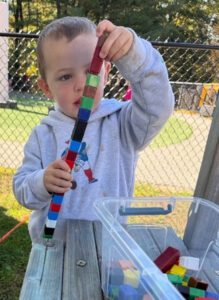
Our Early Intervention Services provide therapeutic services to children ages infant to three years old who are not meeting age-appropriate developmental milestones or are at risk of not meeting milestones. Our services address a wide range of developmental areas and are naturally integrated into families’ routines and cultures.
Speech: A Common Developmental Concern
Concerns about speech are among the most common developmental issues for which families seek Early Intervention Services to assess their child and provide appropriate support. Speech development is an area where we have specialists on staff to help families who are concerned about their child using sounds and words to make their needs and wants known. Parents and caregivers may reach out as they notice that their child may struggle with the output of full words, inability to pronounce certain sounds, or that they lack speech and seem frustrated when trying to communicate. At Early Intervention, our approach is to meet with families and their child to understand their concerns and to assess and evaluate the child. We then develop an Individualized Family Service Plan for the child that is supportive of the family, their routines, and culture.
Early Intervention Services is family-centric, supporting a family wherever their child is in the process of language development. Our speech-language pathologist, Natalie Howard, MS, CCC-SLP, has been working with families for 11 years. Natalie’s goal, when working with families, is to ensure therapy is fun so the child perseveres. As she says: “Growing up is a child’s work and at times, speech-language development is hard work for a child.”
There can be many reasons that a child may have delayed speech, and the speech-language pathologist will work to determine whether underlying issues are impacting development as this will impact the direction of care/support. For example, goals and sessions will be different for a child with a hearing loss vs. a child with a cleft palate repair. Natalie turns her attention to the language the child does have. Part of Natalie’s job is reviewing what a child is doing with their voice, and how a child is moving the lips, teeth, and tongue. Sometimes, what is in a child’s mind can’t leave their mouth and Natalie focuses on how they connect thought to verbalization through the physical movements of the mouth.
“Early Intervention Services have been phenomenal for our child, and it has been amazing to see how much his language has improved in the span of a year. Our specialist has also been wonderful and supportive. It is nice to develop a close relationship with our specialist and to count on them as an additional resource. We highly recommend taking advantage of this service if your child needs it!”
– Jessica, Early Intervention Parent, Andover, MA
Approaching Play with Purpose
Once goals have been identified, Natalie employs the “Total Communication Approach” which uses pictures, signs, word approximations, and words. Word approximations are when a child, for example, may only say eee for eat, unable to finish verbalizing the /t/ sound to complete the word. If a child is consistently making the eee sound when wanting to eat or when eating, Natalie builds upon that sound until the child can fully develop verbalizing eat. Many parents want their child to be able to say “Mama” or “Dada.” To target these words, Natalie practices holding a child, while Mama remains out of sight then naming her when she comes back into sight. Family photo albums may also be created to give the child practice at naming family members.
Another important exercise Natalie uses is called “Play with Purpose.” Natalie works with the child to build vocabulary around favorite play themes or toys rather than pictures of objects. She chooses vocabulary words that will develop early sounds, but they need to be functional. For example, if a child loves the slide, the focus isn’t just saying slide. It’s functionally using words that describe the activity. The repetition would be to go up, up, up to the top of slide and then sit on your bum, then ready, set, go and wheee, down, down, down to the bottom of the slide. As a speech language pathologist, Natalie uses repetition so the child can hear and connect meaning to the activity to verbalize and use the word correctly. Natalie also emphasizes that sign language is another great tool. Spoken words are a collection of sounds; nothing tangible. Sign language gives them visual support and the power to communicate, while helping them shape their mouths to make sounds. Signs are made near the mouth to help key the child into the movements of the mouth for speech while simultaneously seeing the signs.
Family Support to Track Progress at Home
During all this extraordinary work, a word tracker can assist parents and caregivers to monitor, record, and get excited and invested in their child’s vocabulary development. Parents should use trackers for what they’re hearing in the home. This gives Natalie a baseline to understand where a child is, developmentally.
“Our child’s EI specialist recommended keeping a word tracker in the early months so we could observe our child’s growing vocabulary. She suggested we avoid only using words like “this” or “that” [instead] saying things like “do you want the red ball” instead of “do you want this?”
– Jessica, Early Intervention Parent, Andover, MA
Parents may record that the child is saying up whereas the child is only verbalizing uh without the puh. Natalie takes this information and reviews if the child should be making the consonant sounds. While uh is a communicative attempt and is accepted as the word, the verbalization of puh sound is what Natalie works on with the child.

Therapeutic Services for the Child; Support and Tools for the Family
At Early Intervention Services, we are dedicated to providing support for the family while offering therapeutic services for the child to meet them where they are and to help them make advances to achieve positive outcomes for the child and the family. Trackers are intended to be a positive reinforcement for the family, not another task or extra work for them.
If you have concerns about the growth and development of any child aged infant to three years old, including concerns about speech development, please reach out to us to schedule a free assessment. Early Intervention Services can have a positive effect on a child and family’s life at a time when the brain is rapidly developing.
Learn more from our speech pathologist.
Schedule a free assessment.
Learn more about Early Intervention Services.
Contact us.