The teachers and specialists at Anderson School are so creative when it comes to planning events and activities to incorporate into our students’ school experience.
Typically-developing students learn primarily from the senses of seeing and hearing. Most students at Anderson School in Andover, MA have cortical visual impairment (CVI) which affects how they learn.
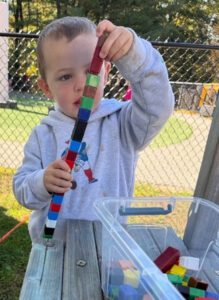
To augment learning (and to have fun), our talented staff incorporates sensory exploration into the curriculum and activities to help students learn through tactile play, exposure to smells, and to activate their proprioceptive system, a complex sensory system that provides us with a sense of body position and movement. These sensory receptors are in our joints, muscle, and skin and can be important to learning.
Sensory experiences are included in daily school activities. If reading a book about a teddy bear, the teacher or specialists may build on the story to incorporate tactile elements such as having students feel a teddy bear stuffed animal to associate the soft fuzzy touch with the story.
Additionally, we have created a full sensory room in our school to offer a sensory experience to our students and their families. Our most recent sensory room set up was a big hit just prior to the holiday season. The classroom was transformed into a room decorated with artwork students had created to contribute to the sensory room décor. Artwork of snowmen made with puffy paint and cups of hot chocolate decorated the walls and ceilings.
One of our speech language specialists and our teacher of the visually impaired (TVI) worked with students to create snowflakes capturing a compliment of another student that hung from the sensory room ceiling.
A Virtual Tour of a Sensory Room
The staff enjoyed the planning as they shared ideas and developed the elements of the sensory room and the areas that would be offered for each student and their family to enjoy.
Especially important was that each student chose how and what they wanted to experience. They had the power of making the choices; for students where so much of their lives are nonnegotiable that experience is freeing and empowering.
Stations were created so a student and their family could enjoy an activity for a while before deciding what they wanted to enjoy next.
Each station had a smell associated with the station (e.g., gingerbread) and students were offered the opportunity to move from station to station.
Sensory Room Activities included:
Gingerbread House with each student choosing to add a giant piece of candy to decorate the house.

A snowman bowling activity where the student could pick up a puffy, soft ball, put it in the machine and use their switch to active the ball to knock down the snowman made of cups.

A giant snow globe was a huge hit as students could activate a fan with their switch to cause the snow globe to light up and the balloons inside to move around like snowflakes within the globe.

A curling/bowling hybrid game was also fun as students could activate a hover ball to knock down bowling pins.

A photo booth offered the opportunity to capture family memories and the final station, a hot cocoa station enabled students to use an adaptive pourer to put the cocoa in a cup and assist their family in making hot cocoa topped off with candy canes and whipped cream.

Benefits of Sensory Room Experiences for Our Students
Two overarching goals of planning and developing sensory room experiences for our students include:
- Fun – an opportunity to be kids and have fun.
- Providing an opportunity for the students to choose and control their experience.
Sensory rooms offer many benefits to our students including:
- Physical movement – reaching and holding
- Language development – connecting words to describe their feelings and to talk about the activity including important ‘help words’.
- Cause and effect – seeing the cause of using their switch to activate a ball to shoot out.
- Helping – the students naturally like to help others and readily helped their parents or siblings with sensory activities.
- Idea generation – families left with ideas of activities for home and naturally encouraged the student to try again or use their other hand.
- Socialization skills – taking turns
- Personalities shine – each student’s personality shines through as they explore and gravitate to what they enjoy.
Sensory exploration is an important building block in helping our student population learn. Creatively incorporating sensory exploration into the curriculum and activities at Anderson School contributes to a vibrant and fun environment where learning is happening and smiles are prominent.
We can’t wait to see what the staff comes up with for the Spring sensory room experience.
Learn more about Anderson School.
Contact us to take a tour.