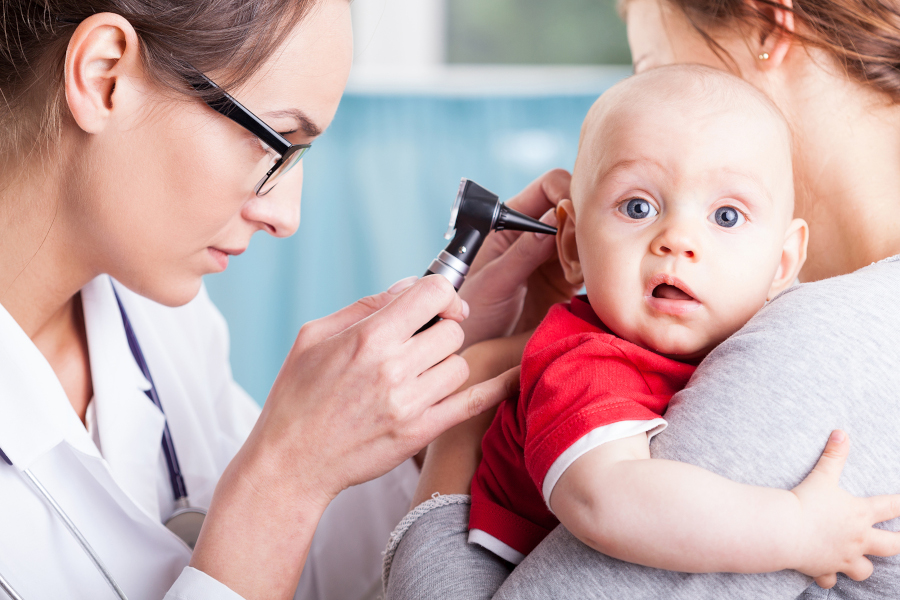
The first three years of life are critical for communication and language development. For infants and toddlers with hearing loss, early support can make a lasting difference. May is Better Hearing Month, an ideal time to highlight how Partners in Child Development’s Early Intervention Services supports young children with hearing loss and their families in building strong communication skills.
Communication is essential starting at birth as families are intently seeking cues and clues from their infant. Infants communicate using cooing sounds and babbling and parents and caregivers typically communicate using words, gestures, and songs. For an infant or toddler with hearing loss, it is especially important to seek Early Intervention Services for assistance to learn language stimulation strategies and to avoid language development delays.
Hearing Loss: Trends in the United States
Universal newborn hearing screening has greatly improved early identification of hearing loss. Today more than 98% of U.S. newborns are screened shortly after birth. Approximately 1-3 out of every 1,000 babies born in the U.S. have detectable hearing loss. While the occurrence of hearing loss has remained relatively steady over time, earlier screening allows families with young children to access support and important intervention services sooner.
Infants with hearing loss
Congenital hearing loss refers to hearing loss that is present at birth and varies from mild to profound affecting one ear (unilateral) or both ears (bilateral). Causes for such hearing loss may be due to genetic factors, structural differences (e.g., auditory nerve or ear canal), prenatal infections, or complications during pregnancy or at birth.
Our Early Intervention Services can begin as soon as hospital discharge; we are commonly referred by the hospital. Families and caregivers appreciate the support to help them develop effective strategies to communicate with their infant.
Support and strategies can include using simple signs and speaking directly and closely (face to face) to help the baby recognize facial expressions. Simple signs from daily activities (e.g., changing your diaper, breast feeding or bottle feeding, or taking a nap) help the infant recognize patterns as they being to anticipate what is happening. We involve all family members who are taking care of the baby to encourage consistency of signs to communicate.
Repetition is essential for developing communication skills. Beginning early helps families establish comfortable routines that support learning and connection.
Simple games such as ‘peek-a-boo’ and imitation of an infant’s sounds are effective in helping the infant and positively affirming their sounds are being heard and responded to. It is interesting to note that infants with profound hearing loss will still coo and babble, including saying mama and dada. Reacting and responding to their sounds is an important positive response to encourage the infant to explore sounds and communicate in meaningful ways.
Hearing Loss After Birth
Some children develop hearing loss after birth due to:
- Frequent or chronic ear infections
- Illness or injury
- Genetic factors
- Exposure to certain medications or infections
If your child has frequent ear infections, there is a risk of language delay. Are you noticing they are not turning their head in response to their name being called? Are they demonstrating a startled response to a loud sound?
We encourage families not to wait if a child has suffered from many ear infections and you have concerns about hearing loss. Toddler’s ears don’t drain fluid well because their Eustachian tubes aren’t fully developed until after age five. This timeframe is unfortunate as developing language skills during this same timeframe are essential to a child’s development. Chronic middle ear fluid, or recurrent otitis media (ear infections) may cause a temporary conductive mild to moderate hearing loss. We urge you to reach out to us if you have concerns about hearing loss due to chronic ear infections.
Getting started is as easy as 1-2-3.
Step 1. Reach out to us.
Step 2. In-person evaluation is completed.
Step 3. Early Intervention Services begin.
Our EI specialists offer tremendous insight and skills including sign language and strategies to attract the attention of a child who has hearing loss. Turning lights on and off, waving your hands to attract their attention and using sound vibration are examples of suggestions our specialists may offer.
With family-focused services, we meet our families where they are, respecting culture, values, traditions, and preferences. For parents and caregivers who are members of the Deaf community, we respect their decisions and choices, always. To promote effective communication between our EI families and our EI staff, we have bilingual staff members and translators.
Hearing aids and cochlear implants are available solutions, even for young children. Our Early Intervention Services offers support and guidance for our families and regularly work with young children and their families through the transition to technology to augment their hearing. The brain needs time to adjust to how sound is being processed and our EI specialists including Speech-language pathologists, have the expertise and skills, and are dedicated to working with young children.
Early Intervention Services for Children with Hearing Loss
If your infant or toddler under age three has been diagnosed with hearing loss – or if you have concerns – support is available. Our Early Intervention Services offers families guidance, strategies, and encouragement during this important stage of development. Intervening early helps children build strong communication skills and helps families feel confident and supported.
Communities Served in The Commonwealth
At Early Intervention Services, we assist young children and their families across 12 communities in Massachusetts including the Greater Lawrence communities of Andover, Lawrence, Methuen, and North Andover and the Greater Lowell communities of Billerica, Chelmsford, Dracut, Dunstable, Lowell, Tewksbury, Tyngsborough, and Westford.